In the agriculture and food sectors, everything is still commonly measured in quantities: hectares, tonnes, liters, exports. Analysts, investors, and companies themselves rely on these figures when assessing growth.
Higher yields, growing exports, expanding production — all of this traditionally signals business growth. Yet profitability figures increasingly tell a very different story: larger volumes do not necessarily mean higher profits and, in some cases, can even mean the opposite.
Over the past decades, agricultural productivity in Europe has increased, but profitability across many sectors has remained highly cyclical and under pressure. European Commission data shows that agricultural production prices have grown more slowly than energy, fertilizer, labor, and logistics costs. This means that simply increasing volume is no longer enough — the margin generated from each additional tonne is often shrinking.
Akola Group’s experience shows that value in today’s agri-food business is created less and less through volume alone. Increasingly, it depends on the ability to precisely manage quality across the entire chain — from raw material to final product.
Value Comes From “More Precise,” Not “More”
Commodity-based sectors follow a simple economic logic: the closer a product is to a raw commodity, the less control the producer has over its price. Pricing is dictated by global markets, leaving companies to compete primarily on cost and scale.
But scale has limits. As volumes grow, so do logistics, energy, storage, labor, and working capital requirements — along with the risk of quality fluctuations and defects.
Today, the market does not pay for a tonne as such. It pays for a tonne with clearly defined parameters: stable composition, safety, traceability, and suitability for a specific use.
Across different sectors, this means different things, but the principle remains the same:
- in dairy: protein and fat content, microbiological indicators, consistency;
- in grains: protein, gluten, moisture levels, falling number;
- in feed production: nutritional value, consistency, and precisely reproducible formulations.
Additional criteria are also becoming increasingly important: residue control, certifications, and supply reliability. These are no longer just technical metrics — they are financial indicators.
When “More” Means “Less”
Today’s reality is simple: larger volumes alone do not guarantee higher profits. If growth is achieved by lowering quality, producing lower-value products, or increasing costs, profitability can actually decline.
This often creates a paradox: revenue grows, tonnage increases, but profitability falls. In economics, this is known as the “commodity trap” — a situation where a company grows in scale but cannot improve profitability because it has no control over pricing.
For example, lower-quality grain may fail to qualify for premium segments and therefore must be sold at significantly lower prices. The same applies in dairy or feed supply chains: quality fluctuations mean more losses, customer claims, and lost clients.
Another major risk is overly rapid expansion, when a company can no longer effectively control process quality. In such cases, defects increase, logistics costs rise, operational stability weakens, and margins come under direct pressure.
Quality Is No Longer an Advantage — It Is a Necessity
Another important trend is that value in the agri-food sector is increasingly shifting away from primary production toward the broader value chain: storage, processing, formulations, logistics, data, and customer relationships.
Put simply, higher earnings no longer go to the company that grows a tonne of wheat, but to the company that can prepare it for the market — drying it, sorting it, storing it, processing it, or transforming it into a final product. Each additional step in the chain typically generates higher margins than the raw material itself.
In the future, there will be less and less room in the market for “average” products. Buyers will increasingly seek not just products, but solutions: more stable composition, lower risk, and greater efficiency.
That is why quality today means more than the ability to sell at a higher price. It means the ability to access the market at all, retain customers, and operate profitably.
The numbers demonstrate this clearly:
- the difference in milk purchase prices between low- and high-quality milk can reach EUR 0.05–0.10 per liter;
- wheat prices can differ by EUR 30–50 per tonne solely due to quality parameters.
In some markets, premium-grade wheat can be 20–30% more expensive than feed-grade wheat. When working with hundreds of thousands of tonnes, these differences translate into millions of euros.
The conclusion is very straightforward: quality today is a direct financial metric.
The Winners Will Not Be the Biggest, but the Most Precise
Future competition in the agri-food sector will increasingly revolve not around who produces the most, but around who can measure, manage, and consistently reproduce quality most precisely.
That requires infrastructure: laboratory testing, automated monitoring, formulation control, data analytics, and traceability systems. Without these capabilities, it becomes increasingly difficult not only to grow, but even to maintain profitability.
This is especially important given structural pressure on the sector: by 2050, global food demand is projected to increase by 50–60%, while agricultural land area may expand by only around 5–10%. This means value will need to be created not through expansion, but by extracting more value from the same resource base.
As a result, the central question in modern agribusiness is changing: not “how much did you produce,” but “how much value did you create?”
And that is what will ultimately determine the true market leaders.
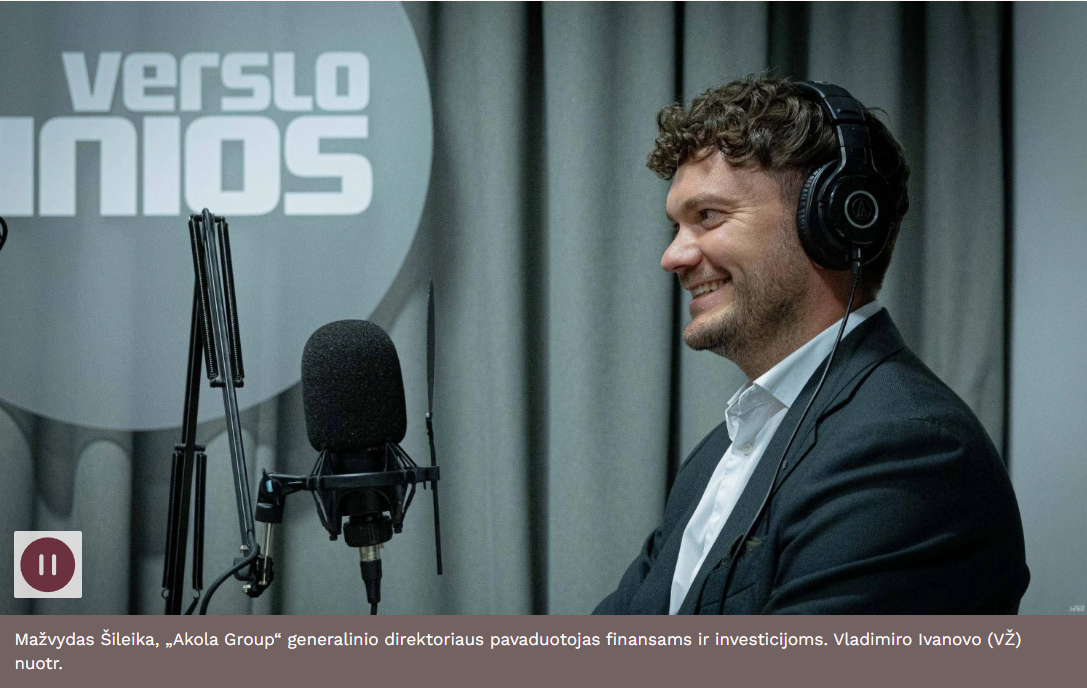
Commentary by Mažvydas Šileika, Deputy CEO for Finance and Investments at Akola Group